The core principles
All my guidance is are done within a high-level framework formed upon the following core principles. These are not new concepts, they are fundamental rules of high performance organisation.
Two things are critical for any organisation:
- People - without whom there would just be an idea about doing something, and
- a Purpose - without which there is just a group of people with nothing to do.
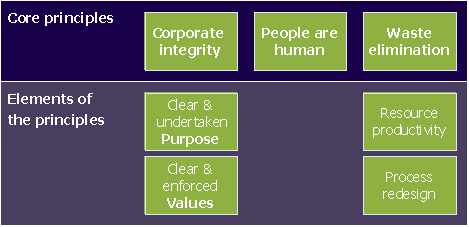
Corporate integrityCorporate integrity is the state in which all activities of an organisation are expressions of its purpose. Clear purpose & values An organisation must have a clear purpose for its people to know what to do. It also needs a clear set of values for them to know how to do it. There must be processes in place to clarify, communicate and enforce the purpose and values. It is only when this corporate identity is quite clear, understood, and undertaken that the organisation has integrity. It is what it declares itself to be, and the inevitable proof is in its actions. From this point of integrity, staff know how to do their jobs, customers know what to expect, and investors are inevitably rewarded by a well performing company. |
People are humanValue and respect your people as individuals with their unique contribution to make and the contribution they do make will exceed their job description. By 'people' I mean anyone involved in the business: staff, management, customers, investors, suppliers, regulatory bodies, the families of these people, etc. People, by their nature, want to do things that make them happy and don't want to do things that make them unhappy. So if your people are happy they will perform well and the business will prosper. Likewise, if they are unhappy, performance and interest will deteriorate and so will your business. If people are treated as just functionaries fulfilling job descriptions (cogs in a machine), they will feel unrespected and become unhappy. Consider: value your people more, and they will provide you with more value. |
UnwastefulnessRedefining waste as 'non-saleable product' makes it easy to see that waste makes no business sense; why produce something that you can't sell, re-use, or is otherwise valuable? Waste takes on many forms in an organisation: waste by-product, frustrated people, time, energy, asset deterioration, etc. The solution is to either find a buyer for the waste, or redesign business processes and systems so that it no longer creates this non-saleable product. Another key to eliminating waste is increasing resource productivity: get more out of the same amount of resources (raw materials, time, people, etc). An organisation cannot be completely aligned with achieving its purpose if it is also aligned with producing waste, which by definition is not a part of the corporate purpose. |
This alignment of people with business purpose is what drives great and powerful achievement.
Sustainable success
Sustainability is being able to meet your current needs without compromising your, or others', ability to meet future needs. It implies the ongoing availability of business operation, raw materials, human effort, and so on.
Success is the measure of achieving your business' defined purpose.
Acting sustainably does not necessarily create corporate success and success is not always sustainable. But when acting sustainability within a state of corporate integrity, an organisation will be successful ongoingly.